In today's society, people pay attention to their own health, and environmental factors are also one of the important reasons that affect people's health. The air pollution makes the smog more and more serious, people have to wear masks when going out. With the continuous improvement of people's awareness of environmental protection, equipment that damages the ecological environment is gradually being eliminated, and the development of charcoal machine equipment is bound to replace the original charcoal.
Because neither our country's economic or environmental development methods can develop retrogressively.
Let us introduce the advantages of machine-made charcoal compared with the original charcoal production method?
1. More environmentally friendly: The raw materials for the production of charcoal machines are diversified, and waste can be turned into treasure. The original method can only destroy the ecological environment by cutting down trees.
2. Good cleanability: machine-made charcoal has no probe, burning without sparks, and small ash content.
3. High energy: The calorific value of machine-made charcoal is about 1000-1500 kcal/kg higher than the charcoal caused by traditional methods.
4. Low water content: The charcoal produced by the charcoal machine undergoes a series of treatments and the originally manufactured charcoal has lower water content.
5. A particularly obvious advantage is that the shape rules, length, and size are relatively uniform.
The above analysis is that the replacement of the original charcoal with a charcoal machine is an inevitable reason for development. Now, whether it is rural or industrial, machine-made charcoal is used, which shows that the market for machine-made charcoal is very extensive.
Monday, April 13, 2020

Friday, April 10, 2020
Precautions for installing charcoal dryer
When you buy a wood dryer home, the technician's wood dryer company will return to your home and install it for free. The following are the precautions for installing the wood dryer:

Wood dryer
1. Foundation acceptance, mainly check the foundation concrete pouring quality and size position deviation. Its appearance requires that the foundation surface is clean, free of oil stains, dust, debris, no exposed steel bars, no crack angles, and no casting defects such as residual shell plates in the expected holes. The deviation of the size and position of the foundation should meet the following requirements: For the shape, size and position of the basic coordinates, the error of the vertical axis and the horizontal axis is less than 20 mm. The elevation error of different planes is less than 20 mm, only Xu and Negative are not allowed to be positive, the total length of slope error is less than 20 mm, whether the discharge end is allowed to be positive, the unevenness of the upper plane is less than 5m, and the total length is less than 10 mm.
2. Wood drying equipment inspection, packaging wood drying equipment, parts, components, standard parts, inventory and other random documents supplied by the anti-skid control device, sent to the wrong check for missing parts, deformation and damage, etc., and used for good records, so install Before that, purchase or prepare. When packaging transparent protective coatings and coatings of dust, grease, rust spots, etc., as well as handling, caused damage during transportation, the received dressing is deformed. The key fitting part is pre-detected and pre-arranged to avoid rework of the installation work and ensure the progress of the installation quality of the installation.
three. Prepare the installation process, including basic installation procedures, basic installation procedures, installation process methods, and safety technical requirements. Then set the bottom plate, determine the reasonable layout of the bottom plate, and pay attention to the bottom plate should be as close as possible to the anchor rod, placed at the center of gravity of the load, to prevent uneven load on the bottom plate. The number of base plates in each group shall not exceed 5 pieces. Thicker pads should be placed up and down, thinner pads should be placed in the middle, and stacked pads should be in good contact. When the adjustments cannot overlap completely, the contact area should be greater than 80%. The bottom plate and the foundation should have sufficient contact accuracy so that the foundation is tightly contacted, placed stably, and there is no hollow angle sloshing phenomenon, ensuring that the bottom plate is tilted up and down the same as the foundation in the longitudinal direction; it should be basically horizontal in the horizontal direction. The baseline marking adopts the optical theodolite, laser collimator or the wire drawing method with poor precision to horizontally level and align the roller base, and repeat the vertical alignment several times until the coordinate position, horizontal horizontal and vertical inclination angle meet the requirements.
Sawdust dryer main structure and characteristics
The main structure and characteristics of the dust collector of the wood chip dryer. The wood chip dryer is a mechanical device designed and manufactured for the drying of sawdust, small wood chips, wood veneers, and wood chips. The main principle is to apply the principle of thermal communication. There is plenty of contact in the barrel to complete the purpose of evaporating water, drying, and dehydration under the action of high temperature.
Feeding installation: Wet wood chips are fed into the wood chip dryer barrel. The built-in "rotary rake crushing" installation belt in the first drying stage breaks up and crushes the wet materials, and converts the wet materials into loose particles that are easy to dry Under the action of the board, it is fully contacted with hot air, dried countercurrently, and quickly evaporates most of the water. In order to remove the biological water in the wet material, the wood chips are transferred to the second drying stage of the wood chip dryer.
At this time, the material and the hot air stop counter-current drying, and the material is repeatedly lifted in the middle layer from time to time, which not only fully absorbs the heat distributed by the inner drum, but also absorbs the heat of the middle drum to reach a better dry state. The material moves to the other end of the middle layer and falls into the outer layer. The material travels in a multi-loop way in the outer drum, and the two-step and one-step backward travel mode make the material that reaches the dry effect quickly travel out of the drum.
Industry advantages of new charcoal machine
The longer the extinguishing time of charcoal, the more users can be trusted. When purchasing a charcoal machine, you want to consume high-quality charcoal. The performance of high-quality charcoal is the length of extinction time. When charcoal is extinguished for a long time, the amount will be reduced, and the cost can also be used sparingly. Therefore, as long as the charcoal that has been extinguished for a long time is more popular.
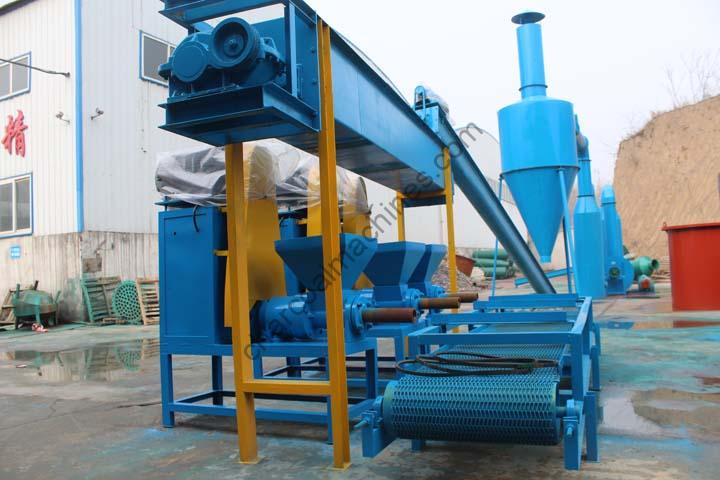
So what is the way to improve the extinction time of the charcoal consumed by the charcoal machine? Progress in the charcoal machine rod making machine using the forming pressure of the original parts, and then increase the density and strength of the rod. After the final carbonization temperature of the high carbonization furnace (or carbonization kiln), and slow down the heating and cooling rate, the produced carbon has high density and high hardness. Of course, the quality of the charcoal machine itself is also very important.
Good quality guarantees efficiency guarantees output and is capable of preventing unnecessary losses. Therefore, the purchase of charcoal machine should choose a professional manufacturer. With China's attention to the environmental protection industry, various environmental protection products and equipment are constantly being produced. The new charcoal machine is one of them. The charcoal produced by the new charcoal machine is widely used and has good development prospects and stable development space, It Is a good investment project for the majority of users.
The charcoal machine produces charcoal with a wide range of raw materials, low prices, inexhaustible and inexhaustible. Some raw materials do not even cost money, such as wood processing residues: sawdust, wood chips, bamboo chips, bark, board bark, etc. Firewood forest, forest logging residues: branches, tree roots, etc .; agricultural and forestry by-product wastes: chaff, walnut shells, chestnut shells and other fruit shells and cores.
Wednesday, April 8, 2020
Analysis of seven common faults of charcoal machine
1. Charcoal machine molding machine does not produce rods
the reason:
A、The raw material moisture is too large.
Solution: Dry the raw materials
B. If the temperature is too high or too low or too high, the insufficient feed will be produced, and if the temperature is too low, the resistance will be too large. Both of these situations will cause the machine to fail.
Solution: Adjust the temperature of the temperature control meter to reach the appropriate temperature.
C sleeve is seriously worn. The sleeve will continue to wear when working, and to a certain extent, it will not push the stick.
Solution: Replace with a new sleeve.
The diameter of the D propeller head channel is too large or too small, or the angle does not match the diameter. If the diameter is too large or too small, the squeezing force is too large or too small. Will leave the stick in the sleeve and not get out. This is also the reason why the extrusion angle does not match.
Solution: Constantly change the size, when it is easy to use, remember this size, and follow this size when the next repair.
2. Bright surface (or bright bowl) is a bright spot on the cross-section of the stick. Although such a stick is dense enough, it is easy to fold.
Cause: The front end of the propeller is too steep.
Solution: Polish the starting point more smoothly.
3. Mechanism charcoal surface crack
A. Causes of lateral cracks: excessive moisture can cause lateral cracks, and excessive temperature can also cause lateral cracks
Solution: Dry the raw materials and lower the heating temperature.
B Longitudinal crack cause: If the water content is too small, a longitudinal crack will occur.
Solution: Adjust the firepower during drying to achieve proper dry humidity.
4. Air return performance is that gas is ejected from the discharge opening, and no longer sticks.
Reason: The gas produced by A with too much water can not be completely discharged from the front end, it is squeezed out from the discharge port.
Solution: Dry raw materials.
B insufficient feed
Solution: Increase the height of the propeller leaves to increase the amount of feed.
CThe heating temperature is too high. If the heating temperature is too high, the supply will be insufficient.
Solution: lower the temperature or increase the height of the propeller leaves.
5. Mechanism charcoal rod bending
Reason: The moisture is too large.
Solution: Dry raw materials.
6, boring car
Cause: A large amount of debris is mixed into the raw material A. The molding machine has certain requirements for the particle size of the raw materials, generally not more than 1.2CM. If mixed with large particles of debris, it will be boring.
Solution: need to stop to take out the debris.
B The heating temperature is too low. If the temperature is too low, the resistance will be too large, and the power of the motor is not enough to push the rod out, and it will be boring.
Solution: Increase the heating temperature.
7. The artillery is displayed as a high-speed gas ejection accompanied by a loud noise
Cause: The tip of the A axis is not correct, so the gas cannot be discharged.
Solution: Heat up and straighten the shaft tip.
The excess water vapor generated by B is too large to be discharged.
Solution: Dry the material.
C thruster is too big or too small
Solution: adjust to the appropriate range
D Improper temperature control
Solution: adjust to the appropriate range
Charcoal carbonization process
Although the charring stage is not the most expensive stage in the entire charcoal production process, it is decisive. If this work cannot be carried out effectively, the entire production process will be in a dangerous state, because with the consumption of bar and the increase in cost, the low output of the carbonization stage will inevitably lead to inefficiency of the entire production chain.
The core of the competition between carbon plants that are normally produced in the same area is carbonization technology. The same amount of salary rods are taken to different carbon plants for carbonization, and the quality and quantity of the final finished carbon are different because of the difference in carbonization technology level. Scientific and reasonable kiln body design, a good kiln burning method is the key to producing more charcoal. This directly affects the level of profitability of a carbon plant.
Charcoal semi-finished products-the main components of the fuel rod include cellulose, wood fiber and water. Among them, cellulose and wood fiber and some other components are closely combined, which is why the mechanical strength of the salary rod is. Water is absorbed in the cellulose/wood fiber structure in the form of water molecules. The water content of the baton is generally below 9%.
This water will be dissipated in the form of water vapor before the effective carbonization process begins. The heat comes from the burning of a small number of fuel rods in the kiln. This is the so-called drying stage. Since the raw materials undergo strict drying treatment before being formed into salary rods, the drying stage in the carbonization process takes less time and requires less heat.
When the moisture content of the salary rod is close to zero, we need to continue to increase the temperature in the kiln. The heat required still comes from the burning of some of the rods in the kiln. When the temperature rises to 280 ° C, the sticks will spontaneously decompose, producing charcoal, methanol, acetic acid, and more complex chemicals. These chemicals often appear in the form of tar and non-condensable gases containing mainly hydrogen, carbon monoxide, and carbon dioxide. Because the air is allowed to enter the kiln, there is also a part of nitrogen from the air in the gas.
Only when the carbonized residue can be called charcoal, the carbonization and spontaneous decomposition will end. Unless more heat can be provided, the process will be terminated. At this time, the temperature reaches its maximum value of 400 ° C. However, this charcoal still contains an estimated amount of tar residues and native wood ash. The ash content of charcoal is about 3%-5%. Asphalt residue content is about 30%.
The rest is the so-called solid carbon, about 65%-70%. Further heating can increase the solid carbon content by removing and decomposing more tar. When the temperature reaches 500 ° C, the typical solid carbon content of 80% and volatile content of about 10% can be obtained. The charcoal extraction rate at this temperature is about 2.6: 1. The charcoal extraction rate will decrease with the increase of the final carbonization temperature.
Charcoal burning kiln technology
It should be pointed out that the carbon yield shows a certain difference due to the different types of raw materials. In addition, the structure of the kiln and the method of burning the kiln directly affect the carbon yield, so the numbers in the table are only used as parameters for your reference.

Although a lower carbonization temperature can obtain a higher carbon yield, this charcoal has low quality and corrosiveness and contains acid tar substances, so it cannot be burned with a clean smokeless flame. The solid carbon content of high-quality commercial carbon should be higher than 80%, which requires us to control the final carbonization temperature above 500 ℃.
The wood fiber content of the raw material has a positive effect on the production of charcoal. Charcoal production welcomes mature materials with a strong structure. Dense wood can generally produce dense and strong charcoal. However, as the carbonization temperature increases, the fragility of charcoal will also increase. In actual production, it was found that when the final carbonization temperature is between 550 ℃ and -650 ℃, the fragility of charcoal and the solid carbon content Time can achieve a more ideal balance.
The key to the burning kiln is to control the kiln temperature. Through the adjustment of the air inlet, the purpose of controlling the temperature of the kiln can be achieved. The stable heating and cooling process is the guarantee for burning high-density charcoal. Taking the climatic conditions of Jilin in spring as an example, the entire process from ignition to charcoal discharge takes about 9 days, so that charcoal with a more ideal density can be obtained.
For the southern carbon plant, the cycle is longer. The high-temperature carbon refining stage after the end of the spontaneous decomposition stage determines the solid carbon content of the charcoal. If you want to burn good charcoal, you must work hard to control the kiln temperature and high-temperature charcoal. In addition, the kiln body must be kept sealed at all times, and no air leakage is required, which requires us to be very careful when building the kiln, especially in the drying stage of the kiln body.
Subscribe to:
Posts (Atom)